Remains of Dennis Bell found on Ecology Glacier by Polish team
Posted on

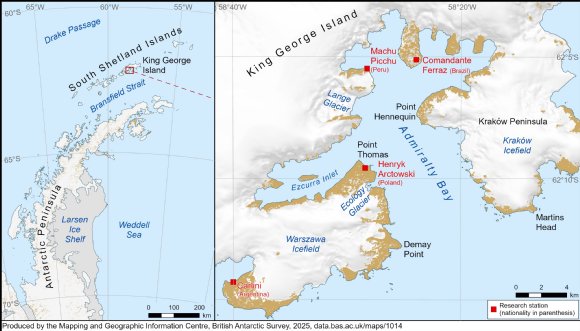
The remains of Dennis Bell have been discovered by a Polish team among rocks exposed by a receding glacier 66 years after his fatal accident. They are identified by DNA as those of Dennis ‘Tink’ Bell, a 25 year-old meteorologist who was working for the Falkland Islands Dependencies Survey (FIDS), the predecessor of the British Antarctic Survey (BAS). He died in a crevasse on a glacier at Admiralty Bay on King George Island, situated off the Antarctic Peninsula on 26 July 1959. His body was never recovered. The story of the accident can be found here. Dennis Bell fatality .
Over 200 personal items have also been found, including the remains of radio equipment, a flashlight, ski poles, an inscribed Erguel wristwatch, a Swedish Mora knife, ski poles and an ebonite pipe stem.
The remains were carried to the Falkland Islands on the BAS Royal Research Ship Sir David Attenborough and handed into the care of His Majesty’s Coroner for British Antarctic Territory, Malcolm Simmons, who accompanied them on the journey from Stanley to London, supported by the Royal Air Force.
The human remains were sent for DNA testing by Denise Syndercombe Court, Professor in Forensic Genetics at King’s College London. She has now confirmed there is a match with samples from his brother David Bell and his sister Valerie Kelly. They are ‘more than one billion times’ more likely to be related than not.
Bell’s brother David, now living in Australia, said: “When my sister Valerie and I were notified that our brother Dennis had been found after 66 years we were shocked and amazed. The British Antarctic Survey and British Antarctic Monument Trust have been a tremendous support and together with the sensitivity of the Polish team in bringing him home have helped us come to terms with the tragic loss of our brilliant brother.”
Professor Dame Jane Francis, Director of BAS said: “The confirmation of the remains found on Ecology Glacier as those of Dennis ‘Tink’ Bell is both a poignant and profound moment for all of us at British Antarctic Survey. Dennis was one of the many brave FIDS personnel who contributed to the early science and exploration of Antarctica under extraordinarily harsh conditions. Even though he was lost in 1959, his memory lived on among colleagues and in the legacy of polar research. This discovery brings closure to a decades-long mystery and reminds us of the human stories embedded in the history of Antarctic science.”
About Dennis Bell
Dennis Bell was brought up in Harrow northwest London where he attended Harrow County School for Boys, now Harrow High School. His brother David commented, "Dennis was the oldest of three siblings and was my hero as he seemed to be able to turn his hand to anything, servicing petrol engines, photography including processing his own films. He built a radio from scratch, spending hours taking down morse code. Other interests included scouting, theatre and eating! Dennis loathed organised sport he just could not see the point. He would rather have a social drink with his family and friends with plenty of laughter."
After leaving school and a brief period in insurance, Dennis Bell joined the Royal Air Force for National Service, trained as a radio operator and then eager for more adventure joined the FIDS as a meteorologist in 1958. He was stationed for a two-year assignment at Admiralty Bay, a small UK base with half a dozen men, on King George Island one of the South Shetland Islands which lie in the Southern Ocean about 120 km off the northern coast of the Antarctic Peninsula. The peak of King George Island rises to 800 metres and is permanently glaciated. Admiralty Bay itself is some 20 kms long and about 5 km wide. It is surrounded by mountains and the sea ices over for nine months of the year.
Dennis was known on base for his humour and larger than life character. Colleague and friend, Russel Thomson who was on base with him has described his practical jokes and spoken of his “tremendous, tremendous character.”
The recovery
The remains were discovered on the Ecology Glacier on 19 January 2025 by personnel from the Henryk Arctowski Polish Antarctic Station on King George Island. Their location was recorded and some were collected and returned to the Arctowski Station, where it was decided that further investigation was required. Between 9-13 February a multidisciplinary Polish team, including an archaeologist, geomorphologist, anthropologist and glaciologist, undertook a more extensive archaeological survey. As a result, more bone fragments and artefacts were recovered.
The Polish team comprised of:
Piotr Kittel - archaeologist, geomorphologist, University of Lodz, Faculty of Geographical Sciences, Department Geology of Geomorphology
Paulina Borówka – anthropologist, University of Lodz, Faculty of Biology and Environmental Protection, Department of Anthropology, aDNA Laboratory
Dariusz Puczko – glaciologist, Institute of Biochemistry and Biophysics Polish Academy of Sciences
Artur Ginter – archaeologist, University of Lodz, Faculty of Philosophy and History, Institute of Archaeology, Laboratory of Spectrometry and Thermoluminescence Dating
Artur Adamek – geodesist, Skala 3D
The family will now decide how to mark Dennis’s memory. Bell Point, King George Island, 62° 06' 41” S 58° 51' 56” W is named for Dennis Bell.
BBC News at 10 on 11 August 2025 covered the discovery in considerable detail with Antarctic footage and interview with Tink's brother. You can follow the two-minute item prepared by Georgina Rannard here.